The Sun will not die quietly. In approximately five billion years, it will exhaust the hydrogen in its core and begin burning the shell of hydrogen around it. The core will contract, heat up, and the outer layers will expand enormously. The Sun will swell into a red giant, growing large enough to swallow Mercury and Venus, perhaps Earth — the models differ on this detail — before eventually shedding its outer layers in a planetary nebula and leaving behind a dense white dwarf the size of our planet, slowly cooling over trillions of years into darkness.
This is the fate of an ordinary star. But the universe produces stars across ten orders of magnitude in mass, and mass determines almost everything about how a star lives and how it dies.
The Gentle Death: White Dwarfs
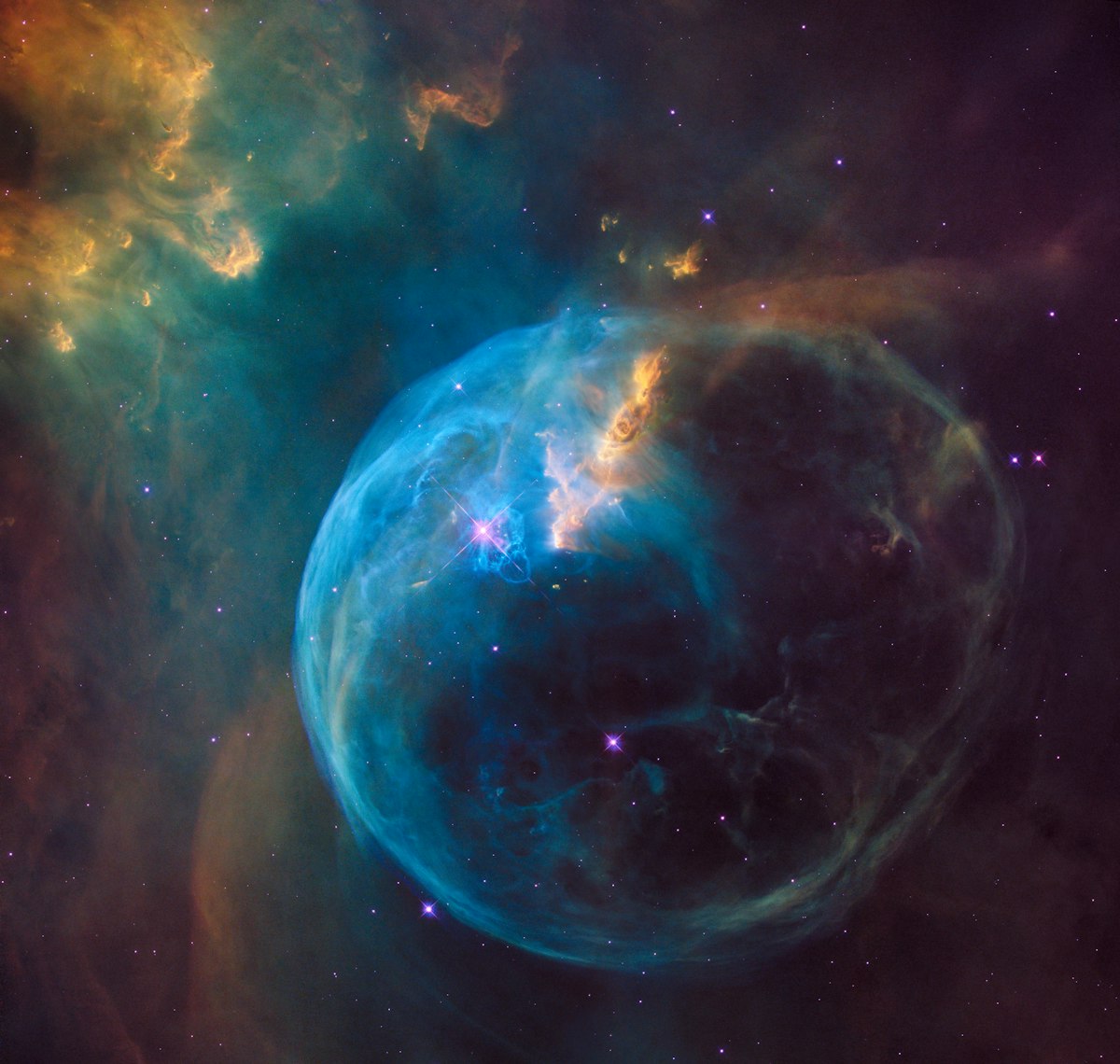
Stars with less than about eight times the Sun’s mass — which accounts for the vast majority of all stars ever born — end their lives as white dwarfs. After the red giant phase, the outer envelope is expelled as a shell of glowing gas: a planetary nebula, one of the most beautiful structures in astronomy, backlit by the exposed stellar core within.
Key Takeaways
- Stellar mass is the primary determinant of how a star dies; low-mass stars become white dwarfs, high-mass stars end in supernovae.
- The Sun will become a red giant, then shed its outer layers as a planetary nebula, leaving a white dwarf cooling over trillions of years.
- Core-collapse supernovae occur when a massive star’s iron core collapses in milliseconds, releasing more energy than the Sun emits over its entire lifetime.
- Neutron stars are among the most extreme objects in the universe: 20 km across, 1.4 solar masses, spinning hundreds of times per second.
- Black holes form when the remnant mass after a supernova exceeds roughly three solar masses and gravity overcomes even neutron degeneracy pressure.
That core is a white dwarf: a ball of electron-degenerate matter, roughly Earth-sized, with a surface temperature initially measured in tens of thousands of Kelvin. White dwarfs have no ongoing fusion; they are cooling embers. The universe is not yet old enough for any white dwarf to have cooled into a black dwarf — that process takes longer than the current age of the cosmos.
The Violent Death: Core-Collapse Supernovae
Stars more massive than about eight solar masses cannot end gently. Gravity wins in a different way. After cycling through heavier and heavier fusion reactions — hydrogen to helium, helium to carbon, carbon to neon, neon to oxygen, oxygen to silicon — they build up an iron core. Iron is the endpoint of stellar nucleosynthesis: fusion of iron absorbs energy rather than releasing it.
Within milliseconds, the iron core collapses. A volume roughly the size of Earth compresses to roughly the size of a city. The collapse releases more energy in those milliseconds than the Sun will emit over its entire 10-billion-year lifetime. The infalling outer layers rebound off the newly formed neutron star, and the result is a core-collapse supernova: a blast visible across billions of light-years.
What remains is a neutron star — a sphere of neutron-degenerate matter 20 kilometres across, containing 1.4 solar masses, rotating perhaps hundreds of times per second, threaded with magnetic fields a billion times stronger than anything achievable on Earth.
Key Takeaways
- Stellar mass is the primary determinant of how a star dies; low-mass stars become white dwarfs, high-mass stars end in supernovae.
- The Sun will become a red giant, then shed its outer layers as a planetary nebula, leaving a white dwarf cooling over trillions of years.
- Core-collapse supernovae occur when a massive star’s iron core collapses in milliseconds, releasing more energy than the Sun emits over its entire lifetime.
- Neutron stars are among the most extreme objects in the universe: 20 km across, 1.4 solar masses, spinning hundreds of times per second.
- Black holes form when the remnant mass after a supernova exceeds roughly three solar masses and gravity overcomes even neutron degeneracy pressure.
Dr. Elena Vasquez
Dr. Elena Vasquez holds a PhD in astrophysics and writes Celestium's long-form field notes. She specialises in exoplanet atmospheres and the search for biosignatures beyond the solar system.